

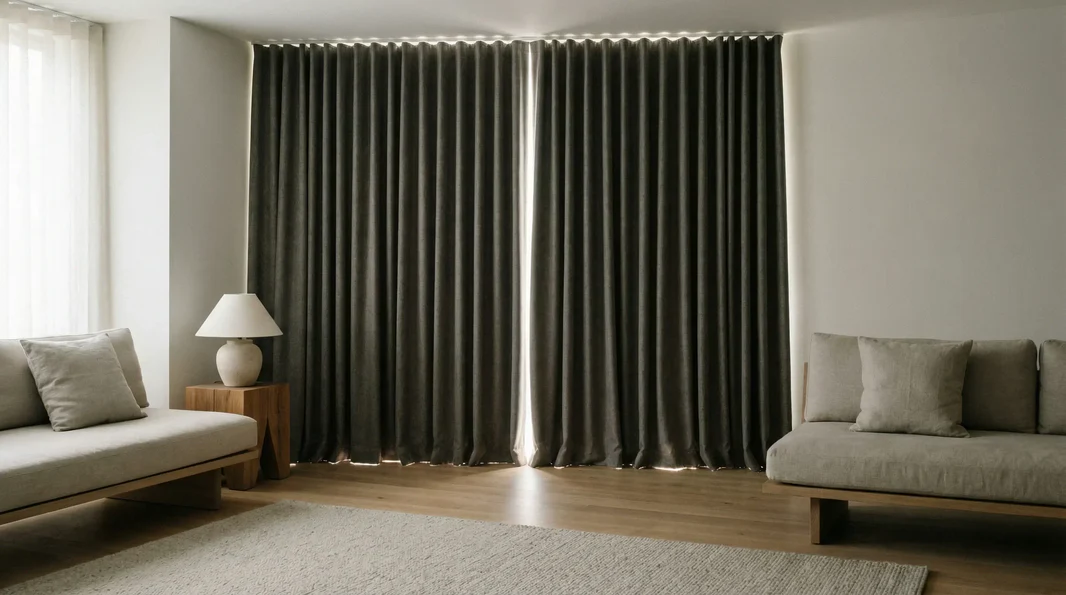
The relationship between blackout curtains sound reduction and the quality of daily life is one that most people discover not by reading about it, but by living it. A bedroom that was once subject to the persistent intrusion of street noise becomes, almost without explanation, a more restful place. A home office that once struggled to compete with the sounds of a busy Singapore neighbourhood settles into something closer to calm. The curtains, heavy and close-fitted against the window frame, are doing more than blocking light. They are absorbing, deflecting, and dampening the acoustic energy that travels through glass and into the spaces where people are trying to think, sleep, and recover.
It is a benefit that tends to come as a surprise, because blackout curtains are so strongly associated with their primary purpose of light exclusion that their acoustic contribution is rarely the leading reason anyone buys them. Yet for a growing number of homeowners, particularly in Singapore’s densely populated residential districts where traffic, construction, and the general hum of urban life are persistent companions, that acoustic contribution has become one of the most valued things these curtains deliver.
Why Sound Travels Into Homes
To understand how blackout curtains for sound reduction work, it helps to understand something about how sound moves. Sound is not a signal. It is a wave, a physical vibration that travels through matter: through air, through glass, through walls, and through any gap it can find between the outside world and the interior of a room.
Windows are a particular weak point. Glass transmits sound readily, and even double-glazed units, common in Singapore’s newer residential developments, cannot eliminate low-frequency vibrations entirely. Traffic noise, in particular, carries a rumbling, persistent quality that single-glazed windows do little to interrupt and that even modern double glazing only partially addresses. The curtain, positioned against or near the glass, introduces a layer of dense, sound-absorbing material directly in the path of these incoming vibrations.
How Blackout Curtains Reduce Sound
The acoustic performance of blackout curtains derives from several physical properties working in combination.
Mass and density
The most fundamental factor in sound reduction curtains is weight. Heavier fabrics with tightly woven fibres absorb more acoustic energy than lighter ones. Blackout curtains, by their nature, are constructed from dense, multi-layered materials designed to prevent light penetration. That same density is what makes them effective at absorbing sound. A curtain that weighs several kilograms per panel and falls in a full, generous stack when closed is doing meaningful acoustic work.
Layered construction
Many blackout curtain products designed for sound attenuation use a triple-weave or multi-layer construction. A typical configuration includes a face fabric, one or more interlining layers, and a blackout backing. Each layer introduces an additional barrier through which sound energy must pass and within which some of that energy is lost. The cumulative effect across all layers is greater than any single fabric could achieve alone.
Coverage and fit
A blackout curtain can only reduce sound effectively if it is hung in a way that maximises its coverage. Key installation considerations include:
Width:
Curtains should be generously wide, typically one and a half to two times the width of the window, so that the fabric stacks in full folds when closed rather than lying flat and thin.
Height:
Floor-to-ceiling installation, with the track or rod mounted close to the ceiling, minimises the gap above the curtain through which sound can bypass the fabric entirely.
Side returns:
Extending the track beyond the window frame on each side, and using a curtain wide enough to wrap around those returns, closes the gap at the edges where sound most readily enters.
Floor contact:
Allowing the curtain to touch or lightly puddle on the floor eliminates the gap at the bottom, which is another common point of acoustic leakage.
The Singapore Context
In Singapore, where residential density is high and the boundary between indoor and outdoor noise is frequently tested, blackout curtains sound reduction address a specific and well-documented problem. HDB flats situated near expressways, condominiums overlooking busy arterial roads, and homes in areas with active construction schedules are all environments where acoustic comfort is a genuine concern rather than a luxury preference.
The Building and Construction Authority of Singapore has published guidelines on acceptable interior noise levels for residential spaces, a recognition that noise intrusion is a measurable quality-of-life issue. While sound-reducing blackout curtains are not a substitute for structural acoustic treatment, they represent an accessible, non-invasive intervention that can make a meaningful difference in rooms where full renovation is not practical.
What Blackout Curtains Cannot Do
An honest account must include the limits. Blackout curtains are not soundproofing. They do not eliminate noise. They reduce it, in the range of five to twelve decibels depending on the fabric weight, construction quality, and installation precision. That reduction is perceptible and genuinely useful, particularly for mid and high-frequency sounds such as voices, traffic hiss, and ambient urban noise. Low-frequency sounds, the deep rumble of heavy vehicles or bass from nearby music, are harder to attenuate with fabric alone and may require additional acoustic treatment.
For most households, however, the reduction that well-chosen and properly installed blackout curtains deliver is precisely what is needed: not silence, but a quieter, more manageable interior.
Final Thoughts
The history of domestic comfort is largely a history of small, cumulative improvements, each one modest in isolation, each one adding something meaningful to the quality of daily life. The case for blackout curtains sound reduction belongs in that tradition: a practical, well-evidenced solution to a problem that millions of households face, available without structural disruption, and capable of making the rooms we depend on for rest and concentration into genuinely better places to be.